Background Diarrheal diseases remain the second leading cause of preventable death globally, particularly
among children under the age of 5 in developing countries, accounting for an estimated 2–3 million deaths annu-
ally. Among bacterial pathogens causing diarrheal illness, Campylobacter jejuni (C. jejuni) remains a major contributor,
particularly in low- and middle-income countries (LMICs). As a common gut pathogen, C. jejuni expresses several
secretory or surface-expressed colonization proteins (SECPs), namely haemolysin co-regulated protein (Hcp), valine
glycine repeats G (VgrG), Campylobacter adhesion to fibronectin (CadF), fibronectin-like protein A (FlpA), and jejuni
lipoprotein A (JlpA). Most of these proteins play pivotal roles in bacterial self-survival, host-cell adhesion, and inva-
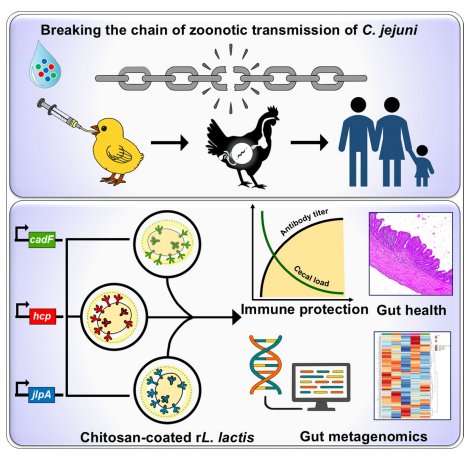
sion of avian and non-avian hosts. To minimize C. jejuni adhesion and subsequent colonization in the avian gut, we
explored the potential of a multicomponent mucosal vaccine composed of CadF, Hcp, and JlpA protein of C. jejuni.
Results For this purpose, we bioengineered a food-grade Lactic Acid-producing Bacterium, Lactococcus lactis (L. lactis),
to express three key immunogenic subunits of C. jejuni, CadF, Hcp, and JlpA. Utilizing this live vector-based multicomponent
mucosal vaccine platform, we investigated the immunoprotective potential of these antigens in chickens. Since the particular
strain of L. lactis is non-colonizing, we used chitosan, a natural mucoadhesive, biodegradable polymer, to microencapsulate
the engineered bacteria and increase their gut retention time for optimal interaction with local immune cells. Our in vivo
immunization study demonstrated that oral administration of this multicomponent vaccine formulation elicited a strong local
antibody response (sIgA) (p<0.0001) and upregulated key pro-inflammatory cytokines, leading to robust mucosal immune
protection (~1.54 log10 reduction) against the cecal colonization of C. jejuni. Beyond targeting C. jejuni, we hypothesized
that the vaccine may influence the overall gut microbiota, potentially promoting a healthier microbial balance in the poultry
gut. To this end, gut metagenomic analysis of vaccinated birds revealed a marked reduction in the phylum Campylobacterota
(~2-fold), accompanied by increased abundance of the phyla Bacteroidota, as part of a beneficial microbial community.
Conclusions: Together, this study underscores the potential of a live vector-based, multicomponent mucosal vaccine
as a promising, cost-effective strategy to reduce the cecal load of C. jejuni, potentially limiting the risk of foodborne
transmission in poultry production systems.
For more details, Click here


